GoDaddy Recommended Agency PartnerAn established CRM Scene credential within the GoDaddy agency ecosystem.
For GoDaddy agency partners
Specialist delivery support for fellow GoDaddy agency partners.
CRM Scene helps fellow GoDaddy agency partners extend customer engagements with Zendesk and customer-operations expertise—through co-delivery, qualified referral, or specialist delivery agreed for each opportunity.
Zendesk Premier PartnerImplementation and customer-operations depth for governed Zendesk delivery.
Zendesk certificationsThe certification count currently published on CRM Scene's Zendesk partner page.
Global delivery coverageRemote and multi-country delivery using CRM Scene's established operating model.
Opportunity signalsWhen the customer experience needs stronger operations behind it.
These are observable patterns—not assumptions about a particular agency or customer.
01
Signal
Customer enquiries land in a shared inbox.
A visible operating pattern worth checking with the customer before proposing a solution.
02
Signal
Sales and support requests are mixed together.
A visible operating pattern worth checking with the customer before proposing a solution.
03
Signal
Routing depends on manual forwarding.
A visible operating pattern worth checking with the customer before proposing a solution.
04
Signal
Zendesk is needed, underused, or difficult to manage.
A visible operating pattern worth checking with the customer before proposing a solution.
05
Signal
The help center is missing or stale.
A visible operating pattern worth checking with the customer before proposing a solution.
06
Signal
Reporting, automation, or AI plans lack a reliable operating foundation.
A visible operating pattern worth checking with the customer before proposing a solution.
Engagement modelsOne specialist desk. Three ways to bring CRM Scene in.
Each model begins with an explicit communication and delivery boundary. None implies a standing referral fee, white-label commitment, exclusivity, SLA, or guaranteed acceptance.
CO
Engagement model
Partner-led co-delivery
The agency normally leads customer communication, with CRM Scene working alongside the agency as an agreed specialist.
Agree first: Before customer contact, agree meeting roles, communication ownership, CRM Scene's visibility, and the introduction wording. Scope, branding, contracting, invoicing, and commercial terms are agreed per opportunity.
RF
Engagement model
Qualified referral
CRM Scene may work directly with the customer after the agency, CRM Scene, and customer agree the introduction and contact path.
Agree first: Before outreach, agree referral attribution, customer consent, the agency's visibility, and who will contract. Scope, branding, invoicing, and any commercial terms are agreed per opportunity.
SD
Engagement model
Subcontracted specialist delivery
The agency normally owns the wider customer project while CRM Scene delivers an agreed Zendesk or customer-operations workstream.
Agree first: Before delivery, agree customer communication, delivery identity, access, acceptance, change control, support, contracting, invoicing, and commercial terms for that opportunity.
Customer pathsFour practical ways to help the customer.
Use the existing CRM Scene service architecture as the destination; the agency branch does not duplicate these services.
01
Customer path
Customer Operations Diagnostic
Entry signal: Ownership, intake, handoffs, and reporting are unclear.
Map the current operating path, expose the highest-impact gaps, and sequence a practical next move.
02
Customer path
Zendesk Operations Launch
Entry signal: The customer is ready to replace inbox-based handling with a governed implementation.
Create structured intake, ownership, routing, reporting, launch controls, and an admin handover.
03
Customer path
Help Center + AI Readiness
Entry signal: Self-service or AI plans are ahead of the knowledge and escalation model.
Build a governed knowledge foundation and safer escalation path before automation expands.
04
Customer path
Zendesk Operations Optimization
Entry signal: Zendesk exists but routing, workflow noise, reporting, or governance limits its value.
Prioritize and control the changes that make a live Zendesk operation easier to run and improve.
Relationship boundaryThe agency relationship stays explicit.
Operating principles
- Record the originating agency on the opportunity.
- Agree the customer-contact path before outreach.
- Agree who leads meetings and customer communication.
- Agree CRM Scene's visibility and delivery identity.
- Put scope ownership, invoicing, change control, handover, and support boundaries in writing.
- Obtain customer consent before an introduction containing customer contact information.
What these principles mean
They guide qualification and delivery planning. They are not implied contractual guarantees. Material scope, branding, contracting, invoicing, commercial, confidentiality, and support terms belong in the written agreement for the opportunity.
Send a consent-aware referral brief →Simple processStart broad, then make the boundary concrete.
01
Check
Use broad, non-sensitive signals to check whether there is a useful starting point.
02
Agree
Choose the engagement and communication model before any customer outreach.
03
Review
Hold a short fit review between the agency and CRM Scene.
04
Confirm
If there is a fit, confirm scope, customer consent, access, and commercial terms.
FAQQuestions to settle before a customer introduction.
Does the agency remain involved?
Yes, when that is the agreed model. The agency can lead customer communication, share delivery, remain visible during a qualified referral, or own the wider project while CRM Scene delivers a specialist workstream. The exact roles are agreed per opportunity.
Can CRM Scene work directly with the customer?
Yes, but only after the customer-contact path is agreed and the customer has consented to the introduction. CRM Scene will not treat an agency referral as permission to begin customer outreach.
Is white-label or subcontracted delivery available?
Subcontracted specialist delivery can be considered per opportunity. CRM Scene does not promise a blanket white-label model; delivery identity, branding, access, communication, acceptance, and support boundaries must be agreed in writing.
Is there a referral fee?
No blanket referral fee is represented by this pilot. If a commercial arrangement is relevant, its eligibility, basis, timing, exclusions, and responsibilities must be discussed and agreed for that opportunity.
What customer information should be shared initially?
Begin with broad operating signals, desired outcomes, approximate scale, current systems, and timing. Do not share passwords, API tokens, exports, ticket content, personal cases, health or payment information, confidential contracts, or customer contact details before consent and a secure path are confirmed.
What types of Zendesk and customer-operations work are covered?
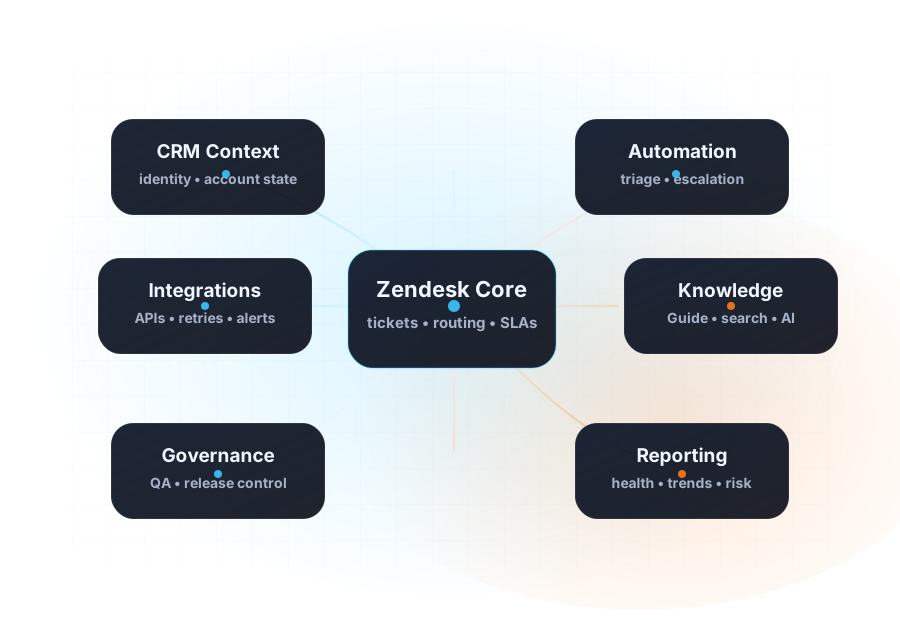
Typical work includes operating diagnostics, Zendesk implementation or optimization, intake and routing, help centers and knowledge operations, reporting, integrations, automation, governance, admin handover, and AI readiness. Final scope depends on the customer and the agreed engagement.
Does GoDaddy or Zendesk endorse this offer?
CRM Scene is a GoDaddy Recommended Agency Partner and Zendesk Premier Partner, but CRM Scene is an independent business responsible for its own services, proposals, pricing, and delivery. These credentials do not mean GoDaddy or Zendesk created, sponsors, guarantees, or accepts responsibility for this agency-partner offer.
Bring the operating problem—not a polished scope.
Use broad signals first. CRM Scene and the agency can then decide whether there is a fit and what must be agreed before any customer contact.